
Trusted By Over 250,000 Customers!
No Interest, No Payments for 12 months on Select Products
No Interest, No Payments for 12 months on Select Products
Bay and bow windows are often mentioned in the same breath, and from across the street they can look nearly identical. Both project outward from the wall, both bring in more light than a standard flat window, and both create usable space inside a room. But they are built differently, work best in different situations, and come with different installation requirements.
If you are trying to decide between the two, or just want to understand what each one actually is before talking to a contractor, this guide covers everything you need to know.
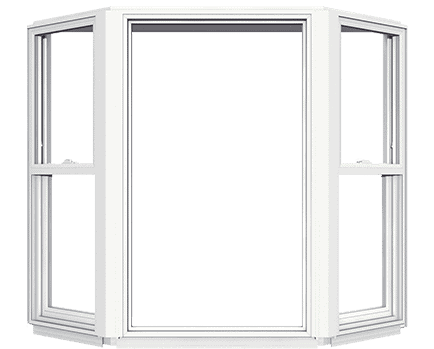
A bay window is a three-panel unit that angles outward from the exterior wall. The center panel is typically a fixed picture window. The two side panels are angled outward, typically at 30 or 45 degrees, and are almost always operable, meaning they open for ventilation. Casement windows and double-hung windows are the most common choices for those side panels.
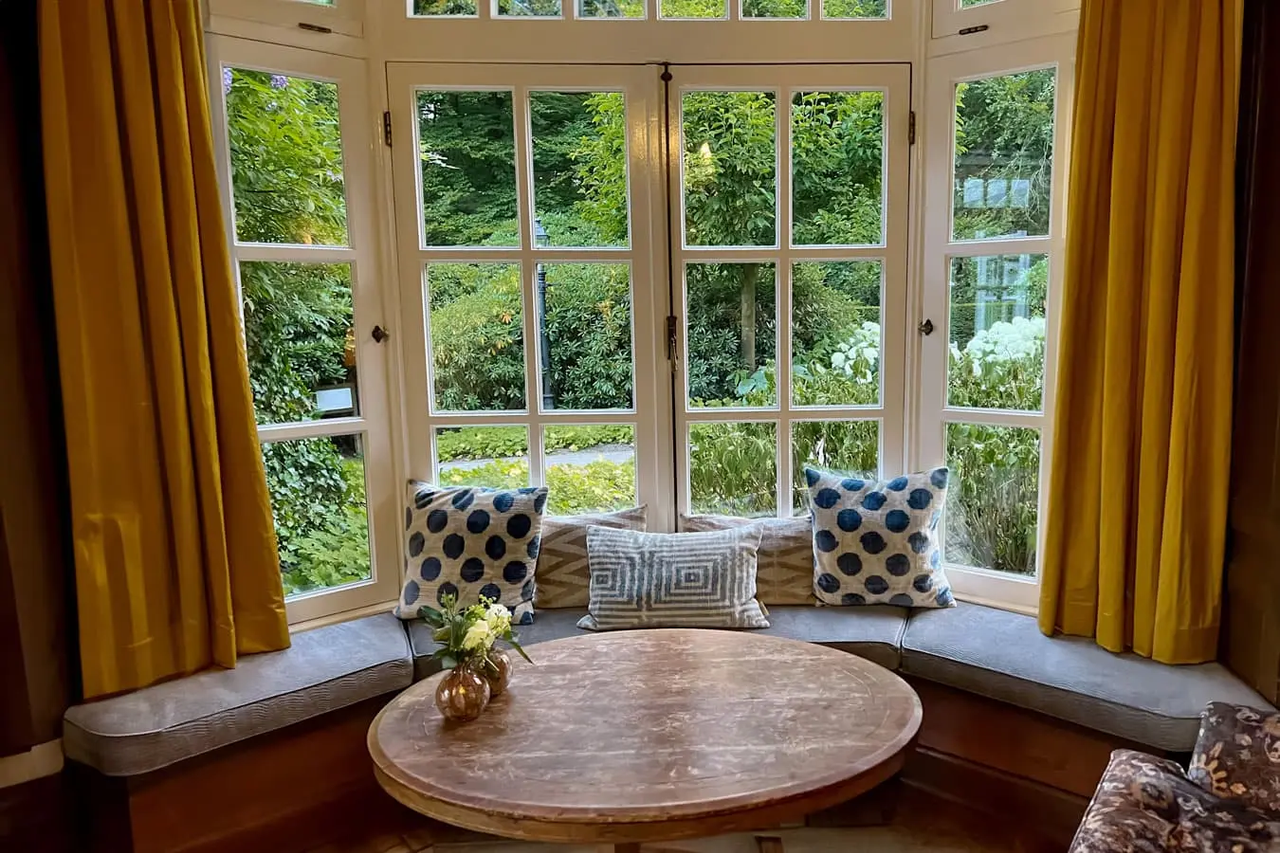
The sharp angles give a bay window a flat face on the front and defined corners on each side. From inside the room, this creates a small alcove with a flat floor and angled side walls. That alcove is what makes bay windows popular for window seats, breakfast nooks, and reading corners.
Bay window projections are typically 18 to 24 inches deep, which means they fit on smaller wall sections. Most installers look for at least 40 inches of wall width to work with, though some configurations can fit tighter spaces.
The angle of the side panels (30° vs. 45°) determines how much floor space the projection adds. A shallower 30-degree angle produces a wider, more gradual projection that tends to look more subtle from the exterior. A steeper 45-degree angle pushes further out into the room, creating a deeper alcove. If you are planning a window seat or built-in bench, the 45-degree option gives you more usable depth. If space is tight outside the wall, such as close to a walkway, a porch, or a property line, the 30-degree configuration minimizes the exterior footprint.
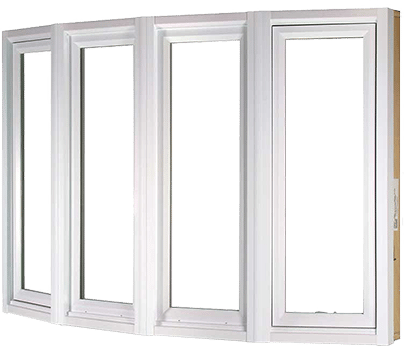
A bow window is a multi-panel unit assembled in a gentle arc. Where a bay uses three panels at sharp angles, a bow uses four, five, or six equal-size panels arranged at shallower, graduated angles of roughly 10 to 15 degrees per joint, so the overall shape curves rather than corners. You may also hear bow windows called “compass windows” because of that rounded profile.
Because the panels in a bow window are all the same size and all set to the same angle, the arc is consistent across the full width. The standard configurations are described by the number of panels: a four-lite bow, a five-lite bow, and so on. The more panels, the more gradual the curve, and the wider the opening needs to be. Most bow windows require at least 80 inches of wall width, and some span considerably more.
The interior projection of a bow window is broader and shallower than a bay. The alcove doesn’t have flat side walls and a flat floor the same way a bay does. Instead, it curves in from both sides, which changes how you can use the space inside and how window treatments need to fit.
| Bay Window | Bow Window | |
|---|---|---|
| Panel count | 3 | 4 to 6 |
| Shape | Angular, flat-faced projection | Gradual curve |
| Minimum wall width | ~40 inches | ~80 inches |
| Interior alcove | Defined corners, flat seat area | Rounded, curved profile |
| Typical projection depth | 18 to 24 inches | Shallower, distributed across more panels |
| Ventilation options | 2 operable side panels | Up to 4 or 5 operable panels |
| Best architectural fit | Contemporary, transitional, cottage | Traditional, Victorian, colonial |
| Relative cost | Lower | Higher |
Both types gather light from multiple angles. A bow admits more total light. A bay concentrates it more directly, which works better when you want defined brightness rather than a broad wash.
Bay windows with casement sides direct airflow efficiently, which makes them a practical choice in kitchens. Bow windows with multiple operable panels move more total air volume but less directionally.
Bow windows provide a wider panoramic view across a larger opening. Bay windows frame a specific view more deliberately, functioning like a picture frame with peripheral depth on the sides.
Both bay and bow windows are significantly more complex to install than a standard flat window. The details are worth understanding before you get into a project.
Any window that extends beyond the wall has to transfer its weight to the structure above it. This means the opening needs a properly sized header, which is a horizontal beam that carries the load of the wall across the gap. Replacing a standard flat window with a bay or bow almost always requires widening the rough opening and adding or resizing that header. This is structural work.
Because the unit projects outward, it cannot rely on the floor joists inside the room for support. Bay and bow windows need either knee braces on the exterior or support cables inside the projection that connect the frame to the structure above. Without proper support, the unit will sag over time, causing glass stress, seal failures, and water infiltration.
The seat board is the horizontal surface inside the projection that forms the floor of the alcove. Because it sits above exterior space rather than conditioned indoor space, it needs insulation. An uninsulated seat board gets cold in winter and causes condensation problems. Quality installations include foam insulation in the projection cavity before the seat board goes on. If you plan to add a cushioned window seat, solid wood or plywood holds fasteners better than MDF.
The top of the projection needs to be sealed against weather. This is done with either a small hip roof (a miniature sloped roof that sheds water away from the wall junction) or a soffit tie-in. The hip roof is generally more durable. If this flashing and roofing work isn’t done correctly, water will find its way into the wall cavity, and that damage may not show up for years.
Important note: Most municipalities require a permit for bay and bow window installations because they modify the structural opening and the home’s exterior envelope. A contractor who does not mention a permit as part of this scope is worth questioning directly.
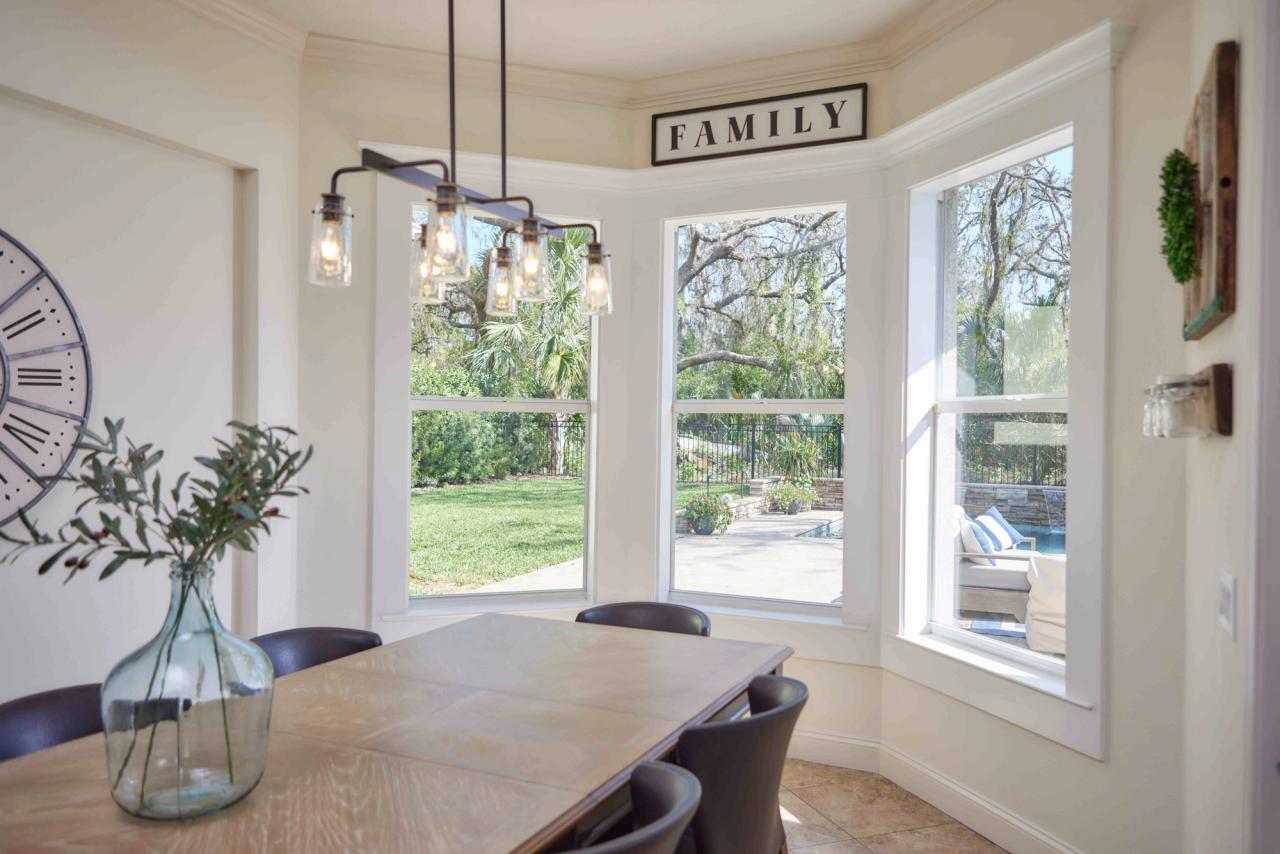
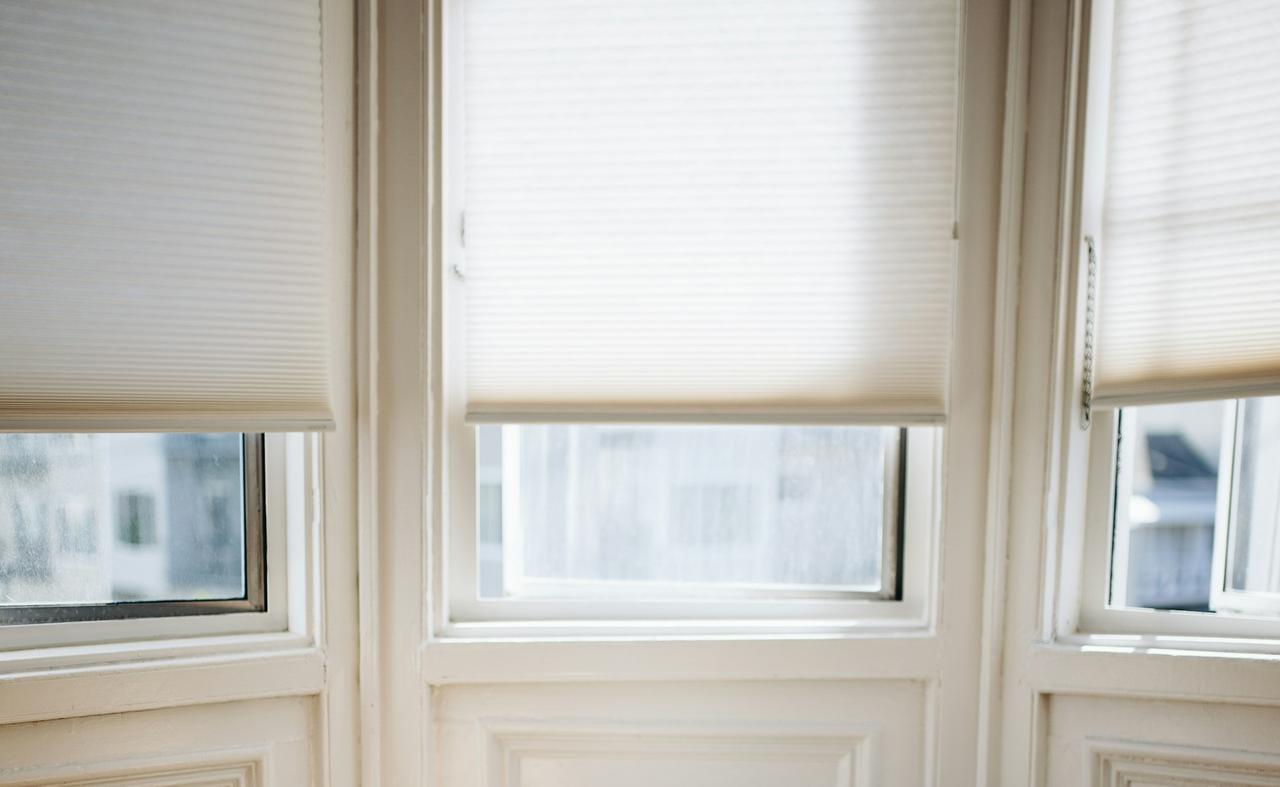
Bay windows are easier to dress. The flat front panel takes a standard blind or shade. The angled side panels can be treated individually or left bare. Cellular shades, wood blinds, and plantation shutters all fit well. For a unified look, a flexible or angled curtain rod across the full bay ties the unit together.
Bow windows require custom or flexible treatments because of the continuous curve. Rigid blinds and standard rods won’t follow the arc. Options include individual shades on each panel, cellular shades fitted to each lite, or a flexible curtain track that bends with the curve. Motorized shades are a popular choice because they cover all panels in one operation. Budget for custom window treatments when planning a bow window project — off-the-shelf solutions rarely fit.
| Bay Windows | Bow Windows |
|---|---|
| Kitchens: The alcove fits a breakfast nook naturally. Operable sides help exhaust cooking odors. | Living rooms: A sweep of glass across a large uninterrupted wall that a three-panel bay cannot match. |
| Living rooms: Adds a focal point and depth to a flat wall on smaller wall sections. | Dining rooms: Creates a dramatic backdrop and floods the space with daylight throughout the day. |
| Bedrooms: The alcove provides enough depth for a cushioned bench with storage. | Turret rooms and corners: Can wrap around a corner or follow the curve of a turret, which is a design option a bay window cannot replicate. |
| Home offices: Light from the front and sides reduces desk shadows. The frame creates a defined task area. | Panoramic view rooms: The wider angle of view captures more of a yard, water view, or landscape. |
Bay windows cost less than bow windows as a general rule, and the gap is meaningful. A bow window has more panels — three vs. four, five, or six — which means more glass, more framing material, and a larger unit to manufacture. Because the panels are set at graduated angles to create a specific arc, the unit often requires custom fabrication rather than standard sizing. The roof tie-in is also wider and more material-intensive. Installation labor is higher because there is simply more to do.
Expect a bow window project to cost roughly 2 to 2.5 times what a comparable bay window project would run in the same space. Cost ranges vary based on size, material, glass options, and local labor rates, so specific numbers are more useful from a contractor who has measured your opening than from a blog post.
Both types are available in vinyl, fiberglass, and wood frames. Vinyl replacement windows are the most common choice for residential remodeling because they offer good energy efficiency with low maintenance and hold up well against the additional weather exposure of a projecting unit. Wood frames look excellent but require more ongoing maintenance in a projecting configuration because they are exposed to weather on more surfaces than a flat window.
Work through these in order. The first question eliminates options before aesthetics or budget even enter the picture.

As a content manager at Renuity, Francheska spent nearly two years helping homeowners discover the possibilities of transforming their spaces. Renuity is a leader in home remodeling, specializing in everything from windows and doors to bathrooms and home storage solutions, and she’s proud to be part of a team that prioritizes quality, innovation, and customer satisfaction. She graduated from Florida International University with a double major in International Business and Marketing, ranked among the top programs in the nation. Her passion for home improvement runs deep—since childhood, she’s been inspired by watching HGTV and seeing the magic of remodels come to life. Now, she channels that passion into connecting readers with ideas, tips, and solutions to create homes they love.
Renuity is backed by top industry ratings and trusted by homeowners nationwide for quality, service, and reliability.





Offer expires:
plus 12 months, no interest,no or low monthly payments
claim offer
Renuity installs both bay and bow windows. Our consultants can assess your wall opening, walk you through glass and frame options, and give you an accurate estimate based on your actual project. No guesswork.
At Renuity, our greatest pride comes from the trust homeowners place in us and the lasting results we deliver. From seamless installations to transformative home upgrades, we’re committed to making every project simple, stress-free, and built to last. Our family of regional brands includes some of the most respected names in remodeling nationwide, all united by proven expertise and a shared commitment to exceptional service. See how we’ve made a difference for families nationwide and what they have to say about their experiences with Renuity.

Patricia Mar was the Renuity remodeling consultant who came to our home, and we couldn’t have asked for a better experience. She was very knowledgeable and explained every part of the project in detai...
Patricia Mar from Renuity stopped by our house to look at our bathroom renovation project. The scope was to convert bath tub shower to walk-in shower. She first listened to our needs, our priorities ...
Susan W was very pleasant, knowledgeable & showed us all the available options for our bathroom. Juan A was the installer, kept the area clean, informed us every step of the way of what was going on a...
Will, from Reunity HI of FM did a great job explaining how to update kitchen cabinets with their high quality door refacing. I was impressed with his knowledge and professionalism. He understood where...
The Gregory team did a great job installing new windows and slider in our house. they were very nice and took care to cover everything and make sure everything was done well without wrecking the rest ...
Brandon and Chris showed up on time and were super professional with installing our garage flooring in our new home. They took their time and made sure everything was done correctly. I would recommend...
I had an excellent experience working with Mike Post. He was professional, knowledgeable, and helpful throughout the entire window-buying process. Mike took the time to explain my options, answered al...
I had two showers installed in my home by Kohler and am so pleased with the experience! The job was completed quickly and efficiently, and I appreciated how smoothly the installation went. Updating tw...
Everyone on this project from the salesperson to the workers and supervisors were friendly, professional, and respectful. The project area was cleaned nightly by the workers. The project was completed...
Kevin from Renuity Kohler is a great salesperson! He was helpful in advising me on the LuxStone shower walls. I liked the White Brick at first. Later I noticed the beautiful design of the Calacatta ...