

Trusted By Over 250,000 Customers!
No Interest, No Payments for 12 months on Select Products
No Interest, No Payments for 12 months on Select Products
Home maintenance isn’t anyone’s favorite weekend project, but skipping it can come with a cost. From cracked bathroom grout and worn flooring to disorganized storage areas, small issues left unchecked can lead to bigger problems that affect comfort, safety, and property value.
As a home remodeling brand, Renuity helps homeowners modernize and protect the spaces most prone to wear — like bathrooms, closets, and flooring. Understanding how Americans handle maintenance sheds light on where these problem areas often start, and how proactive upgrades can prevent long-term damage before it takes hold.
To understand just how far behind Americans might be on their home upkeep, we surveyed thousands of people across the country about how often they think common maintenance tasks should be done, and compared their answers to expert recommendations. We also asked homeowners how often they actually complete those tasks and what gets in the way of staying on top of them.
The results reveal a clear pattern: across nearly every state, homeowners are falling short of the ideal schedule. Some are months — while others are years — behind on basic upkeep. Below, we break down which states are the most overdue, how homeowners’ habits stack up against expert advice, and what these gaps mean for the long-term health of their homes.
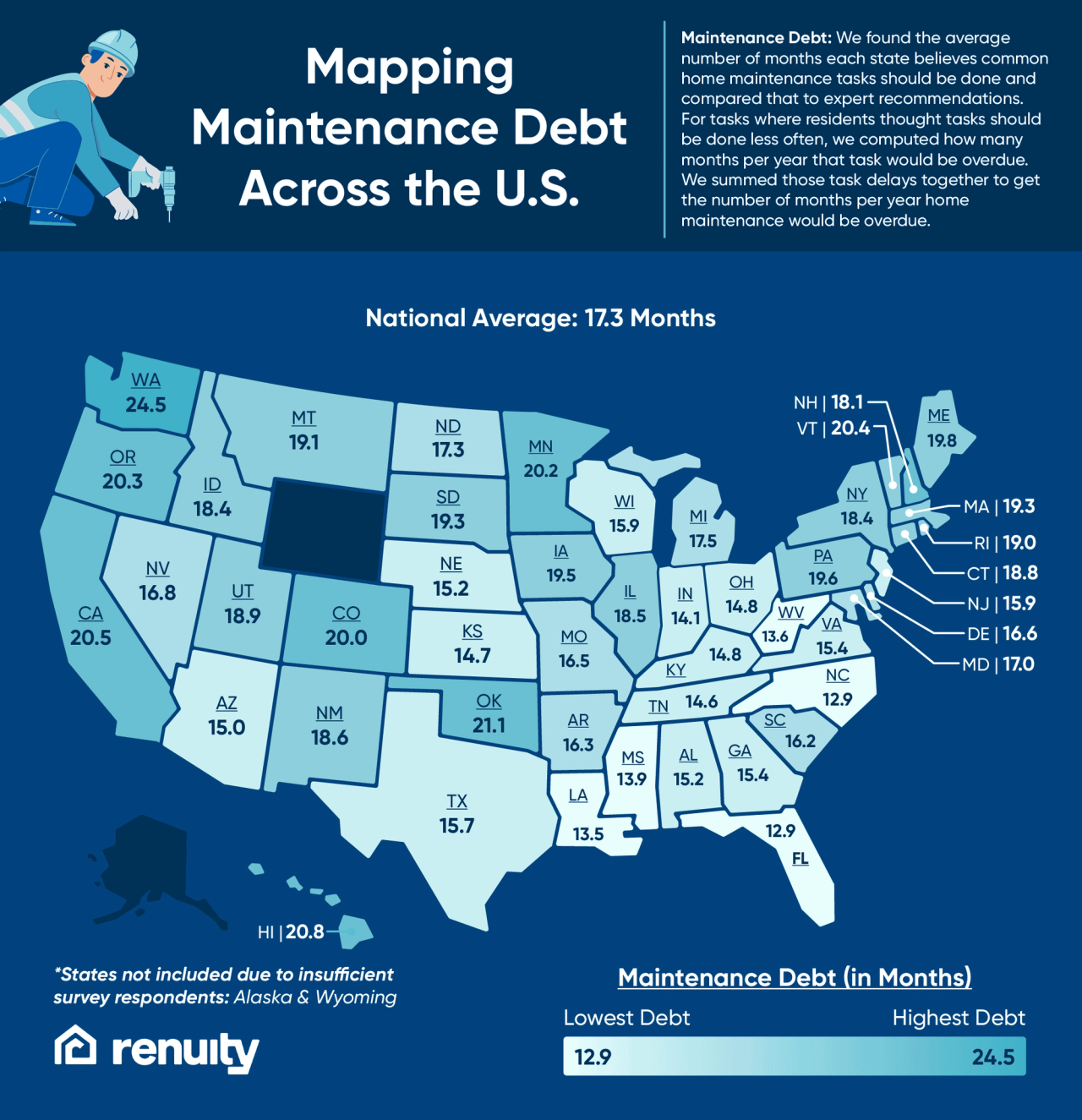
Even the simplest home maintenance tasks can fall through the cracks. But over time, skipping those small jobs adds up. To see which parts of the country are falling the furthest behind, we surveyed people from every state about how often they think common maintenance tasks should be done and compared their answers to expert recommendations.
Using those results, we calculated each state’s total “maintenance debt,” or how many months per year residents are collectively overdue on routine upkeep.
Residents in some parts of the country are more apt to let even basic maintenance tasks go for much longer than suggested. The states below recorded the highest “maintenance debt,” meaning residents’ perceived upkeep schedules trail expert recommendations by up to two years. HVAC filter replacements, water heater flushes, and mold checks are among the most commonly delayed tasks.
Pacific and West Coast states lead the list, and their damp climate means delayed upkeep is more likely to cause swelling or warping in high-moisture areas like bathrooms or around windows and doors. When moisture seeps into flooring, framing, or behind old shower walls, damage often goes unnoticed until it becomes a larger structural concern.
Remodeling these areas with durable, moisture-resistant materials can help homeowners stay ahead of hidden deterioration.
On the other end of the spectrum, we have states whose residents are more on top of their regular maintenance. Though they’re still behind overall, these homeowners keep closer to recommended schedules, particularly for tasks tied to preventing moisture and storm damage.
Southern states tend to stay more current on home maintenance, likely because their warm, humid climates make it harder to ignore issues like mold or moisture buildup. Staying proactive about sealing showers, maintaining caulk, and replacing worn flooring helps prevent humidity-related damage that’s common in these regions. Consistent upkeep in these areas also supports better indoor comfort and energy efficiency, especially in older homes.
Across the country, even the most attentive homeowners are still months behind on simple maintenance. And while these small delays might not seem like much, they can lead to bigger issues over time — from warped flooring to failing bathroom seals or storage areas affected by dampness. For those realizing their home could use some professional attention, remodeling key areas like bathrooms or basement flooring can help prevent recurring maintenance problems and protect a home’s long-term value.
Next, we’ll explore what our homeowner survey revealed about how often people actually perform these tasks, and how those habits stack up against expert recommendations.
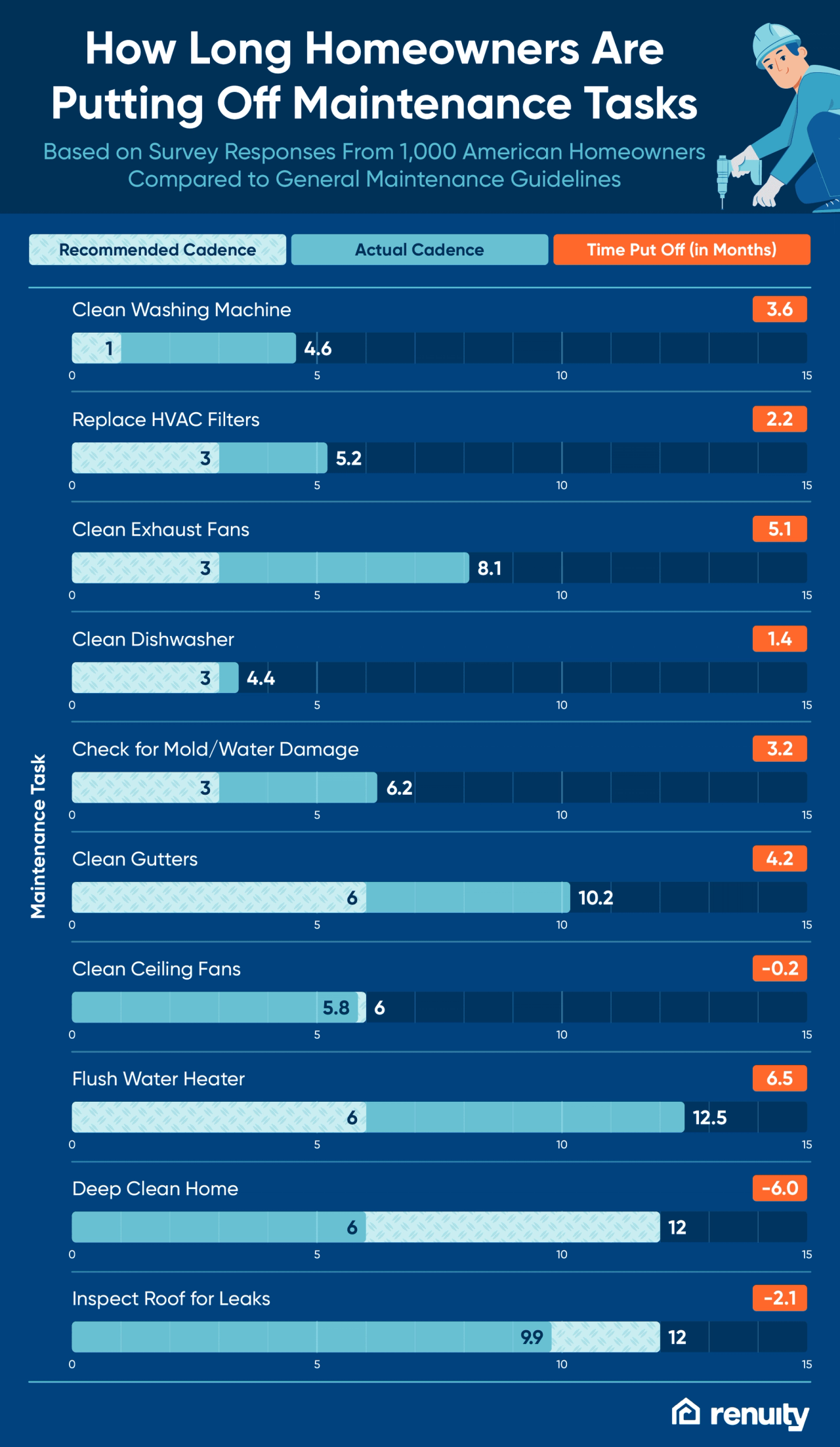
Even the most diligent homeowners can lose track of how often routine maintenance should be done. Between busy schedules and the occasional “I’ll get to it later,” small delays can become long-term neglect. To better understand where homeowners stand at large, we asked them how frequently they perform ten common maintenance tasks and compared their responses to expert recommendations.
Across nearly every category, Americans are letting simple maintenance slide longer than they should. While a few tasks are being done more often than recommended, most are happening months, or even years, later than experts suggest.
The biggest delays involve tasks that are out of sight and easy to overlook — like exhaust fans, water heaters, and hidden signs of water damage. Those same overlooked issues often affect high-moisture areas such as bathrooms or laundry spaces, where neglected caulk or tile seals can allow water to seep in unnoticed.
Meanwhile, visible chores such as cleaning fans or deep cleaning the home are handled more consistently, suggesting that homeowners prioritize what they can see over what prevents long-term deterioration.
When it comes to how homeowners feel about maintenance, most admit they could be doing better. While confidence varies, many still take a hands-on approach to basic repairs.
The most common DIY maintenance tasks include:
Even with that confidence, more than half of homeowners admit they aren’t keeping up:
When asked what’s standing in the way, the top reasons were:
That mix of cost, time, and awareness helps explain why many homeowners delay maintenance in areas that require regular attention, like bathrooms and garages. Left unchecked, small cracks in grout or worn floor coatings can let moisture spread beneath surfaces. The irony is that these problems often start small — a loose tile, an unsealed corner — and grow more expensive the longer they’re ignored.
Some homeowners would rather pay to skip the hassle altogether. On average, Americans say they’d spend nearly $6,000 to never have to do another maintenance task again, though some respondents said they’d pay tens of thousands for a maintenance-free home. Modern remodels that feature easy-clean surfaces, slip-resistant floors, and low-maintenance finishes offer a practical path for reducing upkeep while improving comfort and appearance.
Keeping up with maintenance is rarely exciting, but it’s essential. Regular care prevents bigger problems, protects property value, and extends the life of high-use spaces like bathrooms, laundry rooms, and walk-in closets. For homeowners whose repair lists have grown too long, remodeling those spaces with durable materials and updated designs can make ongoing upkeep easier for years to come.
Across the country, homeowners are falling behind on even the simplest upkeep. From delayed HVAC filter changes to forgotten water heater flushes, routine maintenance often slips through the cracks, and those small lapses can turn into big repairs over time.
Our study shows that while most people understand the importance of home maintenance, the gap between what should be done and what actually gets done continues to grow. Especially in the rooms that see the most daily use. Bathrooms, laundry spaces, and entryways are particularly vulnerable to moisture and wear, and neglected upkeep in those areas can quietly affect a home’s comfort, safety, and efficiency.
For homeowners ready to close that gap, proactive remodeling can make a lasting difference. Upgrading old bathrooms with waterproof materials, refinishing worn floors with protective coatings, and improving storage solutions are all ways to reduce future maintenance and make everyday care easier. These updates not only refresh how a home looks, but also strengthen it against the problems that build up when small repairs are delayed.
Renuity helps homeowners modernize the spaces they rely on most — from bathroom renovations to flooring and home storage upgrades. By addressing long-term maintenance issues through durable design and quality materials, Renuity helps create homes that are easier to maintain and built to last.
To learn more about home maintenance perceptions across the U.S., we surveyed over 3,300 people in total, asking them how frequently they believe basic home maintenance tasks should be done and compared their answers to generally accepted recommendations of how often they should actually be done. We segmented responses to those questions by state and found the parts of the country with the widest gaps in home maintenance knowledge.
We also surveyed a population of homeowners, asking them how frequently they actually do basic home maintenance tasks, how confident they are in maintaining their home, and what the biggest barriers to proactive home maintenance are.
To measure how far behind each state was on upkeep, we created a maintenance debt metric. For every task, we compared the state’s average reported cadence to the recommended cadence, calculated how many months per year that task would be overdue, and summed those delays to find each state’s total number of months behind on maintenance.
States not included due to insufficient survey respondents: Alaska and Wyoming.
You are welcome to use, reference, and share non-commercial excerpts of this study with proper attribution. If you cite or cover our findings, please link back to this page so readers can view the full methodology, charts, and context.

As a content manager at Renuity, Francheska spent nearly two years helping homeowners discover the possibilities of transforming their spaces. Renuity is a leader in home remodeling, specializing in everything from windows and doors to bathrooms and home storage solutions, and she’s proud to be part of a team that prioritizes quality, innovation, and customer satisfaction. She graduated from Florida International University with a double major in International Business and Marketing, ranked among the top programs in the nation. Her passion for home improvement runs deep—since childhood, she’s been inspired by watching HGTV and seeing the magic of remodels come to life. Now, she channels that passion into connecting readers with ideas, tips, and solutions to create homes they love.
Renuity is backed by top industry ratings and trusted by homeowners nationwide for quality, service, and reliability.




Get a free, no-obligation estimate and see how easy it is to upgrade to your dream home. One of our local specialists will reach out to schedule your consultation—on your terms.
At Renuity, our greatest pride comes from the trust homeowners place in us and the lasting results we deliver. From seamless installations to transformative home upgrades, we’re committed to making every project simple, stress-free, and built to last. Our family of regional brands includes some of the most respected names in remodeling nationwide, all united by proven expertise and a shared commitment to exceptional service. See how we’ve made a difference for families nationwide and what they have to say about their experiences with Renuity.

Very professional, pleasant, ahead of schedule . Dealing with Danny Guthrie was pleasant and answered all our questions. Their were no other surprise costs. We loved the service, the contractors wer...
All the people we have dealt with from Renuity from the sales rep, office administration & the installers, have been very good to deal with. On the first day of the installation, they found dry rot un...
This was a very pleasant experience. Lance, my salesperson, was very professional and understood my concerns and needs. Blake and Sebastian, the installers of my new shower remodel, were friendly, har...
We have used Renuity Home Improvement (formerly FHIA) five different times, and every experience has been excellent. They replaced the windows in our previous two homes, completed our parents’ two hom...
We are so pleased with our new shower ! The installing crew were friendly, professional and on time. The appearance of the modern shower is so lovely. We would recommend this company 100% if you wa...
Excellent salesman Wesley was .kind, friendly and knowledgeable...great guy. The brothers were Excellent and beyond, superb work by them and they were fast with the installation. No better place to h...
We had a roof and windows installed by this company. We had 4 companies we were interviewing. FHIA was the second one we met with. Josh came to our home to present their products and servies to us. I...
Great workmanship. Great job. The workers was very professional and explained the installation. Clean up after the job was completed. I would definitely recommend this crew to anyone interest. Thanks...
Conde was very nice and professional with his work , and they kept me informed of the job as it went forward. These are nice windows that should be trouble free for a long time. They were thorough thr...
Now that windows all installed I am pleased with the work, clean up, craftsmanship of products I am pleased. Conscientious of others property. Installed with great care of surroundings. Do recommend...