

Trusted By Over 250,000 Customers!
No Interest, No Payments for 12 months on Select Products
No Interest, No Payments for 12 months on Select Products
When beginning your window replacement project, the process starts with size. The opening you have determines what will fit, which shapes every other decision from there. This guide covers how standard sizes work, what the dimensions on a spec sheet actually mean once a window is installed, and when custom sizing is the right call.
Standard window sizes are the set of dimensions that most U.S. window manufacturers use as the baseline. They exist because homes built since the mid-1970s largely follow modular framing conventions, which means the rough openings in those walls tend to fall into predictable ranges.
Standard size does not mean in-stock or available off a shelf. In the replacement window industry, every window is manufactured to order after you purchase. The advantage of ordering a standard size is that it requires less engineering design time and allows glass to be cut from sheets that manufacturers already stock, which reduces both cost and lead time compared to a fully custom order.
If your home was built before the mid-1970s, its window openings may not conform to modern standard sizes. Pre-modular framing produced more variety in rough opening dimensions, and standard size charts may not apply. A professional measurement will confirm whether your openings are standard before you select a product.
Window manufacturers use a four-digit code to express size. The first two digits represent the width in feet and inches while the last two represent the height in feet and inches.
A window labeled “2840” is 2 feet 8 inches wide and 4 feet tall. Converting to inches: 2 feet 8 inches is 32 inches (24 + 8), and 4 feet is 48 inches, so a 2840 window is 32 inches wide by 48 inches tall.
The notation refers to the size of the window unit itself. The rough opening in the wall, meaning the framed gap the window sits in, is typically a half inch to three-quarters of an inch larger in each direction to allow for shimming and leveling during installation. When ordering, provide your rough opening measurements and let the manufacturer or installer confirm the correct nominal unit size from there.
The window frame and sill components also consume space within the opening, so visible glass area is always smaller than the nominal dimensions. How much smaller depends on the frame profile. Narrow-frame products maximize glass area; traditional profiles reduce it more. When comparing products, ask about visible glass dimensions, not just nominal size.
When getting a free consultation with Renuity, we can help with assessing your needs if you do not have measurements readily available.
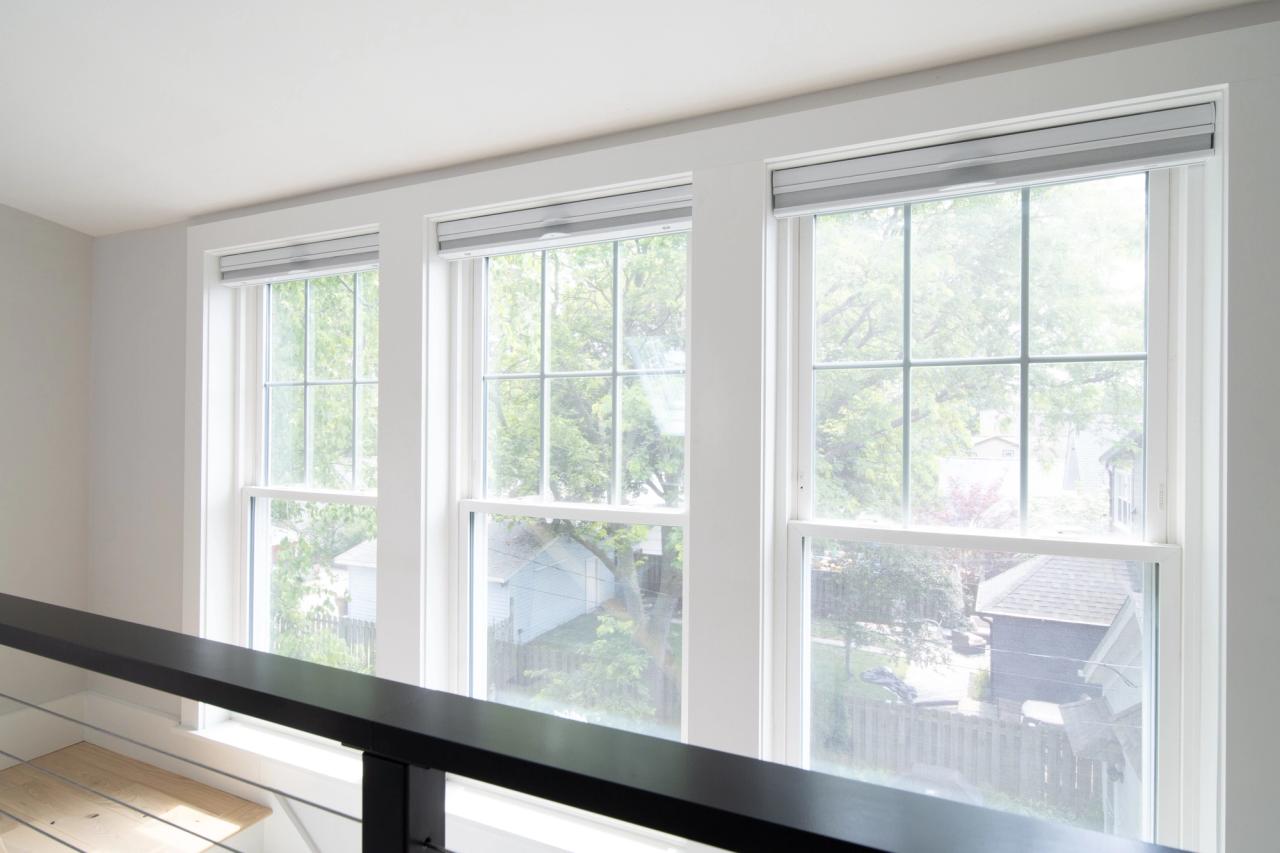
Each window type has its own typical size range because form follows function. A casement window that swings outward on a hinge has practical width limits for operation. A picture window, which doesn't open, can be manufactured much larger.
Single- and double-hung windows are the most common type in U.S. residential construction. Both are taller than they are wide. Single-hung windows have a fixed upper sash with an operable lower sash. Double-hung windows have two operable sashes, which allows for top-down ventilation and makes cleaning easier. For a direct comparison of how the two operate, see single-hung vs. double-hung windows.
Standard widths range from 24 to 48 inches. Standard heights range from 36 to 72 inches.
Casement windows are hinged at one side and swing outward via a crank mechanism. Because the entire sash opens, they provide maximum airflow for their size. They are generally taller than they are wide.
Standard widths range from 16 to 36 inches. Standard heights range from 24 to 72 inches. A single casement panel wider than 24 inches becomes difficult to open against wind resistance, which is why wider casement openings often use paired or mulled units rather than a single wide sash.
Sliding windows open horizontally along a track. They are typically wider than they are tall, which makes them a practical choice for spaces with limited wall height, such as over a kitchen counter or in a basement.
Standard widths range from 36 to 84 inches. Standard heights range from 24 to 60 inches.
Picture windows are fixed, non-opening units designed to frame a view and maximize natural light. Because they have no moving sash or hardware, they can be manufactured in sizes significantly larger than operable window types.
Standard widths range from 24 to 72 inches. Standard heights range from 24 to 84 inches. Picture windows are sometimes combined with operable flanker windows in a single mulled assembly to get both light and ventilation from the same opening.
Awning windows are hinged at the top and open outward from the bottom. They remain functional during light rain because the outward swing creates an overhang effect. They're commonly placed above or below other windows, or in bathrooms and laundry rooms where ventilation matters but privacy is a priority.
Standard widths range from 24 to 48 inches. Standard heights range from 16 to 36 inches.
Bay windows combine a center fixed panel with two angled side panels, typically set at 30 or 45 degrees from the wall. Bow windows use four or more panels of equal size in a gentle curve. Both types project outward from the exterior wall.
Bay window assemblies typically range from 3.5 to 10 feet wide and 3 to 6 feet tall. Because they extend beyond the plane of the wall, installation requires structural support and flashing that doesn't apply to flat replacements.
Every bedroom on the main or upper floors of your home that doesn't have an exterior door requires at least one egress window. The IBC requires the open space to measure at least 5.7 square feet (5.0 square feet for basement windows), be at least 20 inches wide, be at least 24 inches tall, and have a sill no higher than 44 inches from the floor.
This means the open space a person can actually fit through, not the size of the window frame itself. This matters by window type. A double-hung window opens only the lower sash, so the usable opening is roughly half the total unit height. A casement opens the full sash and can satisfy the same requirements at a smaller nominal size. Confirm compliance with your installer before ordering.
Many jurisdictions adopt stricter requirements than the IBC baseline. Verify with your local building department before ordering!
Building codes do not require a window in a bathroom, but they do require adequate ventilation. If a bathroom doesn't have mechanical ventilation ducted to the exterior, it needs a window with a minimum openable area of 1.5 square feet per most code interpretations. Check your local requirements, as this can change from region to region.
Awning windows and frosted casements are the most practical choices for bathrooms because they provide ventilation while limiting sightlines from outside. Common bathroom window sizes run from 24 inches wide by 24 inches tall to 36 inches wide by 36 inches tall.
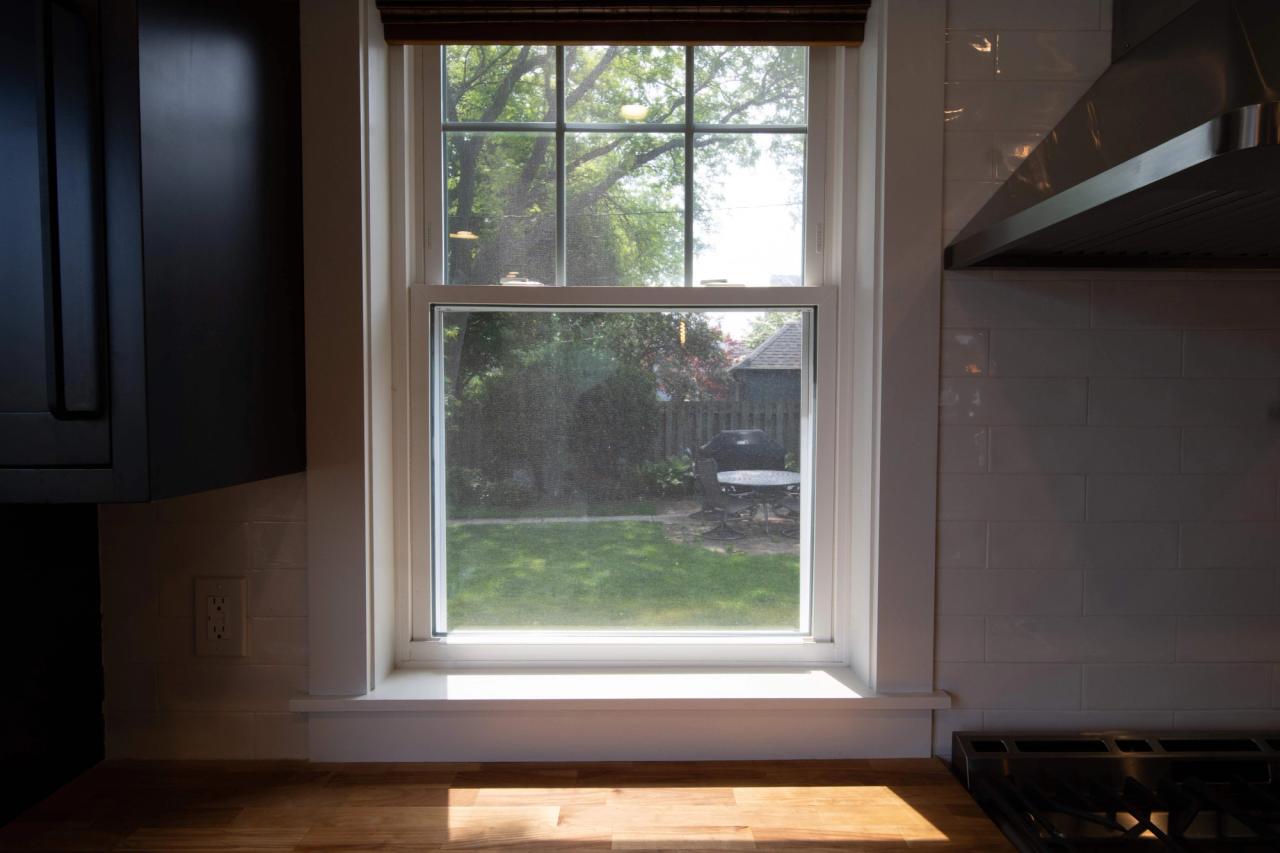
Kitchens have no window-specific code requirements. The practical considerations are ventilation, accessibility (windows over sinks need to open without requiring the homeowner to lean over obstacles), and countertop clearance. Casement windows work well over sinks because they open outward without requiring vertical clearance above the frame. Sliding windows are a good option when depth is limited. Garden windows are a popular option for this area of the home, too.
Common kitchen window sizes range from 30 to 48 inches wide and 30 to 48 inches tall.
Basement bedrooms follow the same egress rules as bedrooms on upper floors, with one difference: the minimum open area drops to 5.0 square feet. The sill can be no higher than 44 inches from the floor. If the window well outside is smaller than 9 square feet, code requires a built-in ladder or step.
The 24-inch height requirement refers to the open space, not the window unit. Once the frame and sash take up their share, the window itself typically needs to be at least 30 to 36 inches tall to clear that threshold. A 36-inch wide by 36-inch tall window is a common starting point for basement egress, but the right size depends on window type and local code. Confirm with your installer before ordering.

Window size notation describes the unit coming off the production line. What actually gets installed in your home depends on the condition of your existing frame and which installation method is used.
Full-frame replacement removes the existing window unit and the surrounding frame (jambs, sill, head) down to the rough opening. The new window is installed to the rough framing, and a new exterior casing is applied. This restores the full rough opening size and is typically used when the existing frame is damaged, rotted, or significantly out of square.
Insert (pocket) replacement leaves the existing frame in place and installs the new window unit inside it. The new window has to be manufactured smaller than the rough opening to fit within the existing frame, typically 1 to 1.5 inches narrower and shorter per axis.
The size on a spec sheet describes the window unit, not the glass area you'll actually see. In an insert replacement, the unit is sized to fit inside the existing frame, so the visible glass area ends up somewhat smaller than it would with a full-frame installation. Ask your installer which method applies to your project before selecting a product.
Before measuring for a replacement window, measure diagonally across the opening from corner to corner in both directions. If the two diagonal measurements differ by more than ¼ inch, the frame is out of square.
A frame that's out of square by more than ¼ inch creates a problem for standard windows, which are manufactured as rectangles. Forcing a rectangular window into a non-square opening produces gaps at the corners, which compromises the seal and allows air and water infiltration. The options are to reframe (during a full-frame replacement) or to order a custom window built to the actual non-square dimensions. A professional measuring appointment will identify this before you order, not after.

If you want to determine whether your windows are standard sizes before a professional consultation, here's how to measure:
One caveat: even if your measurements match a standard size, a professional measurement before ordering is worth doing. Frame depth, interior trim, and installation clearance can affect product selection in ways a tape measure alone won't catch.
Ready to see what fits? Schedule a free in-home window consultation and an advisor will measure your openings, assess frame condition, and confirm which products are right for your installation before you commit to anything.

As a content manager at Renuity, Francheska spent nearly two years helping homeowners discover the possibilities of transforming their spaces. Renuity is a leader in home remodeling, specializing in everything from windows and doors to bathrooms and home storage solutions, and she’s proud to be part of a team that prioritizes quality, innovation, and customer satisfaction. She graduated from Florida International University with a double major in International Business and Marketing, ranked among the top programs in the nation. Her passion for home improvement runs deep—since childhood, she’s been inspired by watching HGTV and seeing the magic of remodels come to life. Now, she channels that passion into connecting readers with ideas, tips, and solutions to create homes they love.
Renuity is backed by top industry ratings and trusted by homeowners nationwide for quality, service, and reliability.





Offer expires:
plus 12 months, no interest,no or low monthly payments
claim offer
Get a free, no-obligation estimate and see how easy it is to upgrade to your dream home. One of our local specialists will reach out to schedule your consultation—on your terms.
At Renuity, our greatest pride comes from the trust homeowners place in us and the lasting results we deliver. From seamless installations to transformative home upgrades, we’re committed to making every project simple, stress-free, and built to last. Our family of regional brands includes some of the most respected names in remodeling nationwide, all united by proven expertise and a shared commitment to exceptional service. See how we’ve made a difference for families nationwide and what they have to say about their experiences with Renuity.

I would highly recommend the sales person, installers and the product itself! Another thing I really appreciated was how the whole team assigned to our project kept us totally informed or arrival time...
Renuity did an excellent job with my bathrooms. I highly recommend the entire experience from consultation to installation.
Mario provided excellent customer service when he came to replace the handle on our impact doors. He was very polite, professional, informative, and knowledgeable. He took the time to explain everythi...
Started out a little rough. The sales report did not get our full vision. Went into the office to cancel. The area manager Ashley-Bills Lagana fixed all our problems and areas of concern. Our bathroom...
Mike Post was very informative. He provided a great presentation of the products they offered. He listened to me to understand my needs and then met those needs.This was the first person I had come by...
Renuity isn’t the least expensive choice for a bath remodel, but their Kohler products and company work ethic are worth every penny. It was very easy to review my choices and set up a plan that fit my...
I don't have before pictures, but there was a 1970's plastic party tub!!!. No shower. Replaced it with a Kohler shower. Absolutely love it!!!. The salesperson was amazing. The install took 2 days. We...
Can't say enough good things about how an amazing job they did. Not only did I have them do my garage floor but they also provided a service to paint my entire garage that was unfinished. Very flexibl...
Maikel and Marcos have been wonderful, very efficient, and friendly. I'd recommend them to anyone that needs window installation. I also would like to mention John, the consultant at the Benjamin Rd....
We are very pleased with our Renuity cabinet refacing project. The finished cabinets look beautiful, and the team worked hard to ensure everything was completed to our satisfaction, resulting in a gre...